Northwest Passage: Epic High Arctic
Back to All ItinerariesExpedition Details
- Duration: 17 days
- Start Location: Calgary, Canada
- End Location: Reykjavík, Iceland
- Embarkation: Kangerlussuaq, Greenland (GL KAN)
- Disembarkation: Kangerlussuaq, Greenland (GL KAN)
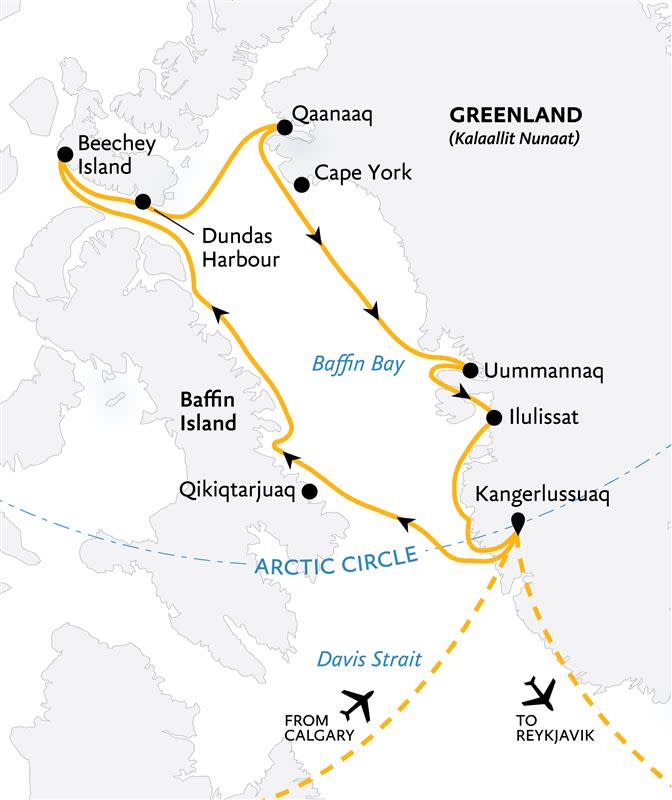
Daily Itinerary
Day 1 - Arrive in Calgary, Canada
Calgary, Canada
Your Arctic expedition begins in Calgary. Explore this vibrant Western Canadian city—much celebrated for its cowboy culture and Prairie hospitality—on your own before spending the night at your hotel, which is included in the Charter Flight & Hotel Package.
Day 2 - Fly to Kangerlussuaq, Greenland and embark
Resolute, CA
After an early breakfast at the hotel, guests will transfer to the airport and board our private charter flight to Kangerlussuaq, Greenland. Upon arrival, you will be transferred to the harbor for the Zodiac shuttle to your awaiting ship. After a late-afternoon embarkation, we will set sail for the stunning Arctic wilderness.
Day 3 - At Sea: Crossing the Davis Strait
Cruising
As we make our way across the Davis Strait, your Expedition Team will offer a series of polar presentations that set the stage for the adventures ahead. You’ll learn about the storied history of the Arctic, its fascinating wildlife, geology and ecology. Our team will also keep a lookout for seabirds soaring above your ship, as well as whales that pass through these waters.
Days 4 and 5 - Exploring Baffin Island, Canada
Cruising
The Inuktitut name for Baffin Island, the fifth-largest island in the world, is Qikiqtaaluk, and it has been home to Inuit for the last thousand years. The island was named after William Baffin, who explored the area in the early 17th century in search of the fabled Northwest Passage. Your days sailing along the island’s eastern coast will be determined by weather and ice conditions, with each day and each landing presenting new adventures. Some of our favorite destinations include Qikiqtarjuaq and Sam Ford Fjord. Expect to see towering mountains, deep fjords, colorful tundra, and Inuit settlements. The Inuit community of Qikiqtarjuaq (which means “the big island” in Inuktitut) is located just north of the Arctic Circle, on Broughton Island. Fondly called Qik by locals, the welcoming hamlet offers a superb vantage point of the Davis Strait. You’ll also have a chance to support local Inuit artisans by purchasing unique artwork, crafts and jewelry. Well inside the Arctic Circle, Sam Ford Fjord is a standout Arctic adventure destination on Baffin Island’s northeast coast, and one of the world’s most spectacular big-wall playgrounds. A traditional Inuit hunting area, the fjord is a study in contrasts: sheer granite cliffs seem to rise straight up from the ocean below, reaching up to 457 meters (1,500 feet) above sea level. If weather conditions permit, this region offers fabulous Zodiac cruising, sea kayaking and paddling as well as opportunities to go ashore. With a bit of luck, we may see Arctic fox onshore, and we’ll keep our eyes peeled for polar bears during our off-shore excursions. Cruising the f jord in a Zodiac is a striking reminder of just how small we are. Winding along a 110- kilometer (68-mile) path, Sam Ford Fjord narrows to less than 3 kilometers (2 miles) wide as it meanders farther inland.
Day 6 - At Sea
Cruising
As our ship sails farther north, you can take advantage of the onboard amenities, deepen your knowledge of the Arctic by attending another polar presentation, sip a cocktail in the bar, watch a documentary film or join your Expedition Team on the bridge as they scan for wildlife—there is no shortage of activities while at sea.
Days 7 to 9 - Tallurutiup Imanga (Lancaster Sound)
Cruising
Lancaster Sound (Tallurutiup Imanga), the gateway to the Northwest Passage, is one of the richest marine habitats in the Arctic. With open-water areas that remain ice-free year-round, it is an important summer feeding area for whales and other marine wildlife. We’ll spend our days exploring several beautiful bays and inlets, visiting historical sites, enjoying Zodiac cruises and searching for such iconic wildlife as walruses, seals and, of course, whales. Polar bear sightings are possible too. If you’re fortunate, you may even spot the elusive narwhal. There may be a possibility for a shore visit at Radstock Bay, the location of one of the most impressive ancient Thule sites in the Arctic. Exploring the well-preserved remains of the subterranean houses, including the whale bones used as supports for the dwellings, will give you an understanding of how these Paleo-Inuit thrived in the Far North. We will attempt to land at Beechey Island, a National Historic Site of Canada. Named after explorer Frederick William Beechey, the island is the final resting place of three members of Sir John Franklin’s 1845-46 expedition to find the Northwest Passage. The graves, on a desolate rocky raised beach, were discovered in 1850 by a search party looking for signs of the ill-fated expedition. Predominantly covered in glaciers and ice fields, Coburg Island and its surrounding waters comprise the Nirjutiqavvik National Wildlife Area. The island’s steep coastal cliffs are an ideal habitat for hundreds of thousands of nesting seabirds such as Brünnich’s guillemots (thick-billed murres), black legged kittiwakes, northern fulmars and black guillemots
Day 10 - Exploring Smith Sound
Cruising
Before saying goodbye to Canada, we’ll try to sail as far north as possible, exploring both sides of Smith Sound, the uninhabited passage between Ellesmere Island and Greenland.
Day 11 - Qaanaaq, Greenland
Cruising
Qaanaaq, formerly known as Thule, is one of the northernmost towns in the world. Here, local Inuit share their culture and traditions, and the museum sheds more light on what it’s like living near the top of the world.
Day 12 - At Sea
Cruising
As we sail south along the west coast of Greenland, our polar experts will present on the history, wildlife and glaciology that will feature in the next few days. We also encourage you to spend time on the outer decks— binoculars at hand—to spot wildlife.
Days 13 to 15 - Exploring West Greenland
Cruising
With spectacular glaciers, soaring fjords and vibrant communities, the west coast of Greenland will leave you breathless. Each community visit in Greenland is a unique experience and Uummannaq might just steal your heart. The red-hued, heart-shaped mountain that rises above the village gives Uummannaq its fitting name, which means “heart-like” in Greenlandic. As your ship approaches the shore, you’ll want to be on deck to take in the incredible view of the twin peaks towering over the vibrantly painted wooden houses dotting the rocky terrain. The settlement was established as a Danish colony in 1758 on the mainland, but it relocated five years later because seal hunting was more plentiful here. As we arrive just south of Ilulissat, which means “iceberg” in Greenlandic, we’ll encounter the impressive Ilulissat Icefjord. The UNESCO World Heritage Site is home to Sermeq Kujalleq, one of the most productive glaciers in the northern hemisphere. As we Zodiac cruise at the mouth of the fjord, you may be lucky to witness the wonders of calving ice (listen to the loud roars as the ice breaks off). Founded in 1741, the traditional town, which boasts more sled dogs than people, is famous in its own right: it was the birthplace of explorer and anthropologist Knud Rasmussen, the first to traverse the Northwest Passage by dogsled, in the early 1920s. Hikes here lead out to stunning views of the young icebergs as they float out the fjord to Disko Bay. In Sisimiut, you’ll be treated to a traditional kayaking demonstration. The kayak (an Inuit word borrowed by the English) has become a national symbol of Greenland and has been used by Inuit hunters for thousands of years. The town has several 18th-century colonial buildings, including the oldest surviving church in Greenland, so take time to wander through the historic area.
Day 16 - Disembark in Kangerlussuaq and Fly to Reykjavik
Kangerlussuaq, GL
Enjoy one more Zodiac ride from ship to shore, where you’ll be transferred to the airport for your charter flight back to Reykjavik, Iceland. Upon arrival in Reykjavik, you will be transferred to your hotel, which is included in your Charter Flight & Hotel Package.
Day 17 - Depart Reykjavik, Iceland
Reykjavík, Iceland
Today, you can make your way home at your leisure or spend some time exploring this fascinating Icelandic capital, known for its Norse history, geothermal culture and distinctive architecture.
What's Included
Rates above include the following:
- Leadership throughout your voyage by our experienced Expedition Leaders, including shore landings and other activities
- All Zodiac transfers and cruising as per the daily program
- All shore landings as per the daily program
- Shipboard accommodation with daily housekeeping
- All meals, snacks, soft drinks and juices on board throughout your voyage (Please inform us of any dietary requirements as far in advance as possible. Unfortunately, the ships’ galleys cannot prepare kosher meals.)
- Free beer, standard wines, spirits, and cocktails during bar service hours and dinner
- Complimentary coffee, tea and cocoa available around the clock
- Formal and informal presentations by our Expedition Team and guest speakers as scheduled
- A photographic journal documenting the expedition
- A pair of waterproof expedition boots on loan for landings and Zodiac cruising excursions
- An official Quark Expeditions® parka to keep
- Hair dryer and bathrobes in every cabin
- Complimentary Wi-Fi service on one device permitting basic Internet browsing, email, posting on social media and voice applications. (Premium packages are available for more data-intensive applications.)
- All miscellaneous service taxes and port charges throughout the program
- All luggage handling aboard the ship
- Emergency Evacuation insurance for all passengers to a maximum benefit of USD $500,000 per person
- Greenland voyages cruise passenger tax
Not Included
Rates above do not include the following:
- Mandatory Transfer Package*
- International airfare
- Arrival and departure transfers in Reykjavik /Calgary
- Passport and visa expenses
- Canadian eTA required for non-Canadian or U.S. visa-exempt passengers
- Government arrival and departure taxes not mentioned above
- Meals ashore unless otherwise specified
- Baggage, cancellation, interruption and medical travel insurance—strongly recommended
- Excess-baggage fees on international and domestic flights
- Mandatory waterproof pants for Zodiac cruising, or any other gear not mentioned
- Laundry, bar and other personal charges unless specified
- Phone and Internet charges (connectivity may vary by location)
- Voluntary gratuity at the end of the voyage for shipboard staff and crew
- Additional overnight accommodation
- Adventure Options not listed in Included Activities